Structural Drying and Dehumidification in Liberty, MO
Framing, subfloor, drywall and concrete are dried with air movers and LGR dehumidifiers sized to the class of loss, and equipment stays until readings reach 2 to 4 points of a dry reference.
(888) 603-7319Get drying equipment sized to the loss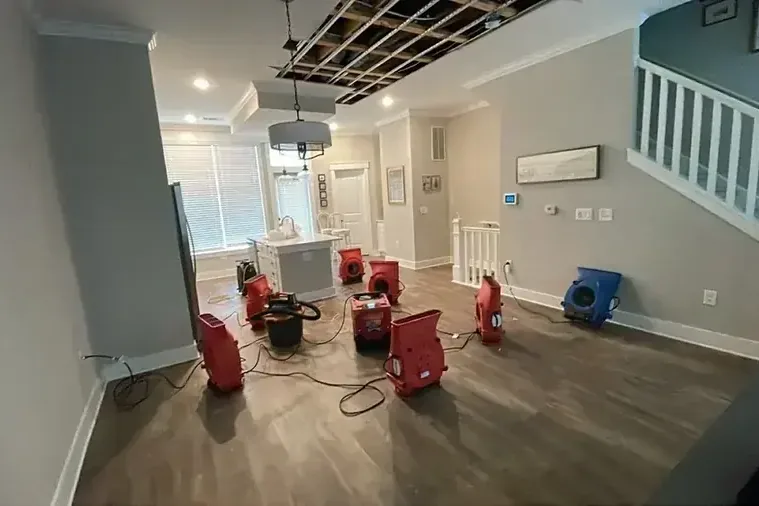
Why structural drying and dehumidification needs a measured dry-out
- Dispatch around the clock. Active water is treated as urgent at any hour, weekends and holidays included, because drywall and subfloor keep wicking until extraction starts.
- Sized to the class of loss. Air movers and LGR dehumidifiers are set by the class of loss under the IICRC S500 drying standard, not by a guess.
- Readings decide the finish. Daily moisture readings track each wet material until it sits within 2 to 4 points of a dry reference in the same home.
- A claim file built during the work. Moisture maps, psychrometric logs and timestamped photos taken before demolition give the adjuster a clear record.
- Lower levels checked, not assumed. Sump pits, floor drains, wall bottoms and the slab edge get metered, not just the spot where water showed up.
First steps for structural drying and dehumidification
- Keep the equipment running. Do not switch off air movers or dehumidifiers between visits.
- Keep doors and windows closed. Closed rooms let the dehumidifiers work on the air inside.
- Leave wet walls open. Do not reinstall baseboards or patch drywall early.
- Stay off wet floors. Limit foot traffic on drying carpet and hardwood.
What does structural drying and dehumidification cost in Liberty, MO?
In Liberty, MO, structural drying typically runs $1,000 to $7,500, depending on the class of loss, the square footage, the materials involved and how many days the equipment runs.
Class 1 to 2, one room
- Air movers and one dehumidifier
- Daily readings
- 3 to 4 days
Class 2 to 3, several rooms
- Multiple LGR dehumidifiers
- Psychrometric logs
- Cavity drying
Class 4, dense materials
- Hardwood or slab drying
- Specialty drying setups
- Extended monitoring
Ranges are typical, not a quote: category of water, square footage, material class and how fast drying started move the number most. Run the water damage cost calculator for a closer range.
How structural drying and dehumidification is handled, step by step
Measure
Set the dry reference and map moisture.
Set up
Place air movers and LGR units by class.
Monitor
Log readings and psychrometrics daily.
Finish
Remove equipment when materials read dry.
Surface dry is not structurally dry. Framing, subfloor, the bottom of drywall and a basement slab hold water long after the room looks fine, and anything closed up wet can warp, smell or grow mold. Structural drying measures the materials, not the air, and keeps going until they read dry.
Class of loss sets the equipment
The class of loss describes how much water the materials absorbed. Class 1 is a small, mostly surface loss; Class 4 means dense materials like hardwood, plaster or concrete. The number of air movers and dehumidifiers follows from the class and the room size.
Room looks dry but the meters say otherwise? The drying team sizes the equipment and logs readings daily.
(888) 603-7319Set up the dehumidifiers and air moversWhat gets measured every day
- Moisture content of framing, subfloor and drywall
- Temperature and relative humidity in the drying area
- Grains per pound inside and outside the containment
- A dry reference reading from unaffected material
The log shows the trend, and equipment is moved or added when a material stops improving.
Basements, slabs and humid summers
A closed basement in a humid Missouri summer slows evaporation, so LGR dehumidifiers pull water out of the air while air movers keep it moving across wet surfaces. Concrete and hardwood can need extra days in Liberty basements. Home moisture and air sealing basics are on Energy Saver, and flood readiness is on Ready.gov.
Structural drying and dehumidification across Liberty and Clay County
Coverage runs across ZIP 64068 and 64069, from Courthouse Square and the historic Dougherty-Prospect Heights and Jewell-Lightburne districts out along Kansas Street, Missouri Route 291 and the I-35 corridor to the homes near Rush Creek.
Nearby coverage reaches Gladstone, Kearney, Kansas City, Excelsior Springs, Smithville, Pleasant Valley, Claycomo and Mosby.
Related water damage services
Structural Drying and Dehumidification questions in Liberty, MO
Still dealing with it?
Room looks dry but the meters say otherwise? The drying team sizes the equipment and logs readings daily.
(888) 603-7319 Set up the dehumidifiers and air moversWhat does 2 to 4 points of a dry reference mean?
The tech reads an unaffected piece of the same material in the home. Wet materials are dried until their meter reading is within 2 to 4 points of that reference.
Why are structural drying dehumidifiers so loud and warm?
LGR dehumidifiers pull a lot of water from the air and release warm, dry air, which speeds evaporation. The noise and heat are normal while they run.
Can the drying equipment be turned off at night?
No. Drying depends on continuous airflow and dehumidification, and turning it off lets humidity climb and adds days.
How long does structural drying take?
Most Class 1 to 2 losses dry in three to five days. Class 4 losses with hardwood, plaster or concrete can take a week or more.
What is a psychrometric log?
A daily record of temperature, relative humidity and grains per pound inside and outside the drying area. It shows whether the equipment is actually removing water.
Why not just use box fans for drying?
Box fans move air but do not remove water from it. Without dehumidification the moisture stays in the room and can soak back into materials.
Walls still damp after the leak? Get the structure dried to a reading.
Moisture left in framing and slabs causes warping and odor. The crew dries until materials match the dry reference.
(888) 603-7319Start the measured dry-out