Kearney is a Clay County city of 10,404 residents at the 2020 census, and it lies in Tornado Alley, where most severe weather arrives in spring and summer. A storm that damages a roof often does its worst work out of sight, in the attic.
Key takeaways
- Kearney is described as lying in Tornado Alley, with most severe weather in spring and summer and some in winter.
- The attic gets wet first, because insulation holds water long before a ceiling stain appears.
- A roofer fixes the leak and the drying team fixes the water, and both jobs need to happen.
- Wet insulation is usually removed, and framing and drywall are dried to measured readings.
- Photographs of the roof, attic and ceiling support any insurance claim.
Why storms leave roofs leaking
Kearney has a humid continental climate, with cold, snowy winters and warm to hot, humid summers. It is described as lying in Tornado Alley, where most severe weather comes in spring and summer but can also happen in winter.
Wind lifts shingles, hail bruises them and flying debris punctures them. The housing count roughly doubled between 2000 and 2020, from 1,995 units to 4,002, so a lot of roofs across the city face the same storm season.
Roof openings are not always dramatic. A lifted shingle or a cracked pipe boot can let in a steady trickle during a long rain.
Hail, wind and winter: what each does to a roof
Wind lifts the edges of shingles and exposes the nailing strip. Hail bruises the surface and knocks off granules, which shortens the life of a shingle even when no hole is visible.
In winter, snow that melts and refreezes at the edge of a roof can form an ice dam, which forces water back up under the shingles.
- Missing, curled or lifted shingles.
- Dents in metal vents, gutters or flashing.
- Granules collecting in gutters and downspouts.
- Daylight or water stains on attic sheathing.
- Icicles and ice ridges at the eaves in winter.
How a roof leak travels
A small opening can let in a surprising amount of rain during a long storm. The water seldom shows up where it entered.
The attic gets wet first
Water runs down the underside of the roof deck and soaks insulation, which holds it like a sponge. The deck and ceiling joists stay damp long after the rain stops.
The ceiling shows it last
By the time a brown ring, a bubbling patch of paint or a sag appears on the ceiling, water has usually been moving for a while. The visible stain is often the smallest part of the wet area.
- A brown or yellow ring that spreads after each rain.
- Paint that bubbles or peels on a ceiling or upper wall.
- A ceiling that sags or feels soft to the touch.
- Drips from a light fixture or ceiling fan.
- A musty smell in a bedroom or hallway below the attic.
First steps after a storm leak
The goal in the first stretch is to limit new water and keep people safe. A saturated ceiling can fall without warning, so the area under it is not a place to stand.
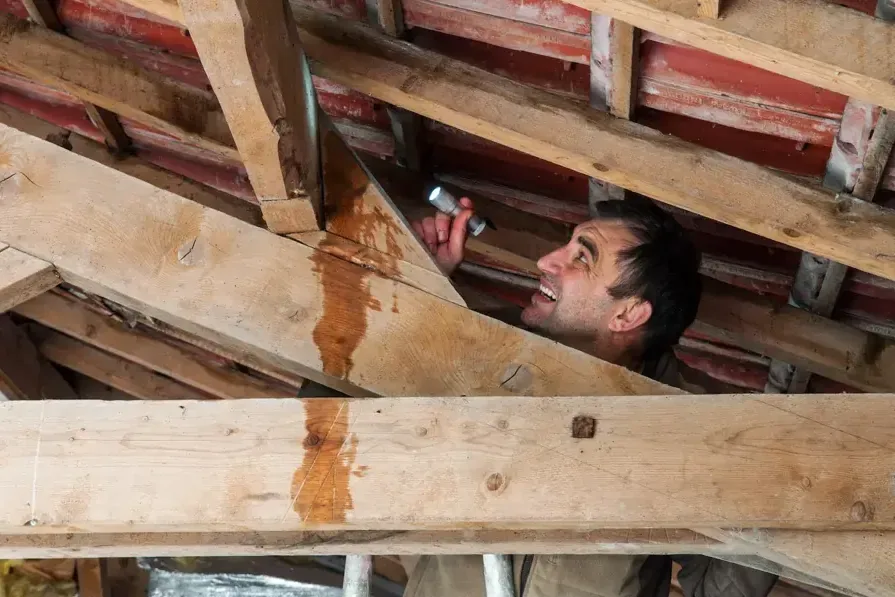
A look into the attic helps, but only from the access hatch with a flashlight. Stepping between joists can break through a ceiling that is soaked.
- Move furniture and valuables out from under the stain.
- Set out a bucket and tarp or plastic where water is dripping.
- Turn off power to a ceiling fixture or fan if it is wet and dripping.
- Photograph the roof damage safely from the ground, then the attic and the ceiling.
- Ask a roofer for a temporary cover such as a tarp over the damaged area.

What the drying team does
The goal is to find all the wet material, not only the stain. Moisture meters and thermal imaging show how far the water traveled across the ceiling and into the walls below.
Work on roof leak water damage follows the readings from the attic down.
Thermal imaging shows cool, wet areas on the ceiling and walls, while a moisture meter confirms the reading in wood and drywall. Together they mark where material must come out.
- Wet insulation is pulled out and bagged, since it does not dry reliably in place.
- Water extraction clears standing water on the floor below first.
- Sagging or stained drywall is cut out, and the bays above it are opened to dry.
- Roof deck and framing are dried with air movers and dehumidifiers.
- Readings continue until they match a dry reference.
Two jobs, one sequence
A roofer and a drying team do different work, and the order matters. A temporary cover stops new rain, then the wet materials come out and the structure is dried, and only then does the permanent repair close the roof back up.
Sealing in damp materials hides the problem for a while. Left wet, attic insulation and framing can grow mold within 24 to 48 hours, so drying should not wait on a long roofing schedule.
- Ask the roofer to document the opening with photos.
- Share the drying log with the roofer so repairs wait for dry framing.
- Keep the temporary cover on until the permanent repair is scheduled.
Insurance and records
Policies differ in how they treat storm damage, so the wording and the deductible matter. Photos of the roof, the attic and the ceiling, taken before any repair, help the adjuster see what happened.
A ceiling stain that appears long after a storm still counts as storm damage when the cause is a roof opening. The ceiling leak water damage work records the readings that show where the water went.
An invoice from a recent roof repair or replacement shows the condition of the roof before the storm. More about local cleanup options is on the Kearney water damage pages.
- Keep receipts for the tarp, roofing work and cleanup.
- Save photos with dates, and list ruined belongings by room.
- Ask the insurer how it handles a leak that shows up days after a storm.
- Note the date of the storm and the date the leak was first seen.
Questions
How can a roof leak show up days after a storm?
Insulation and roof decking hold water like a sponge and release it slowly. A ceiling stain can appear long after the rain has stopped.
Should wet attic insulation be removed?
Usually yes. Wet insulation does not dry reliably in place and keeps framing damp, so it is bagged and removed.
Can a roofer and a restoration crew work at the same time?
They can, with the roofer covering the opening first. Drying works best once new rain is blocked, and permanent roofing goes on after the structure is dry.
Is a sagging ceiling dangerous?
It can be. Saturated drywall can drop without warning, so the area underneath should be cleared and the ceiling opened safely by a crew.
How long does drying take after a roof leak?
It depends on how much insulation and framing got wet. Drying ends when readings match a dry reference, not on a set number of days.
Does hail damage always cause a leak?
No. Hail can bruise shingles without piercing them, and a leak may show up only after repeated storms. An inspection of the roof and attic finds damage that cannot be seen from the ground.