Sewage Backup Cleanup in Kearney, MO
A sewage backup is a contamination problem in any Kearney home, so affected porous materials come out and the area is cleaned and disinfected before the drying work begins.
(888) 603-7319Call to clear the sewage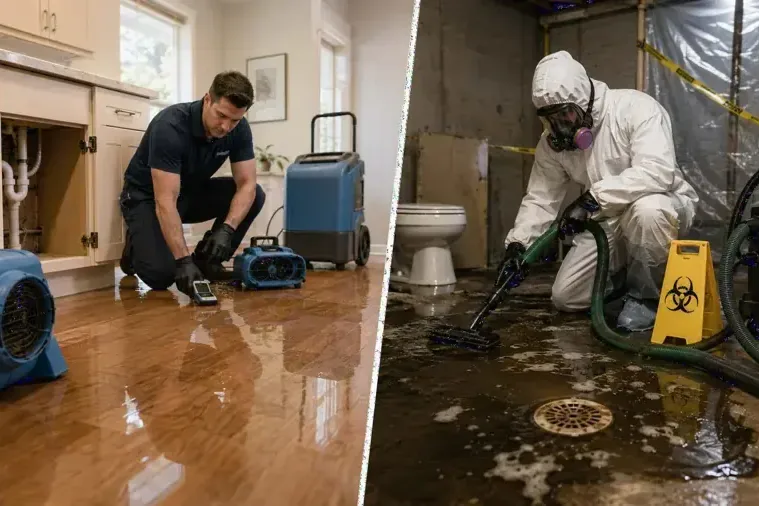
Why sewage backup cleanup needs a measured dry-out
- Dispatch around the clock. Active water is treated as urgent at any hour, weekends and holidays included, because drywall and subfloor keep wicking until extraction starts.
- Sized to the class of loss. Air movers and LGR dehumidifiers are set by the class of loss under the IICRC S500 drying standard, not by a guess.
- Readings decide the finish. Daily moisture readings track each wet material until it sits within 2 to 4 points of a dry reference in the same home.
- A claim file built during the work. Moisture maps, psychrometric logs and timestamped photos taken before demolition give the adjuster a clear record.
- Lower levels checked, not assumed. Sump pits, floor drains, wall bottoms and the slab edge get metered, not just the spot where water showed up.
First steps for sewage backup cleanup
- Suit up and contain. Put on protective gear and seal off the work area.
- Remove the water. Extract contaminated water and take out porous materials it touched.
- Clean and disinfect. Scrub hard surfaces and apply disinfectant to everything that stays.
- Dry and verify. Run dehumidifiers and air movers until readings match dry materials.
What does sewage backup cleanup cost in Kearney, MO?
Sewage backup cleanup commonly costs from $2,500 for a small backup on a hard floor to $15,000 or more for a whole basement, because disinfection and material removal add work.
Small backup, hard floor
- Water removed
- Surfaces disinfected
- Area dried
Finished room
- Carpet and pad out
- Drywall cut back
- Full disinfection
Whole basement
- Contents sorted
- Complete disinfection
- Structural drying
Ranges are typical, not a quote: category of water, square footage, material class and how fast drying started move the number most. Run the water damage cost calculator for a closer range.
How sewage backup cleanup is handled, step by step
Contain
Seal the area and protect clean rooms.
Remove
Take out contaminated water and porous materials.
Disinfect
Clean every surface that stays.
Dry
Verify the structure with moisture readings.
Water that comes up through a drain or toilet is not the same as water from a supply pipe. It can carry bacteria and other contaminants, so the goal changes from simply drying to controlling exposure, removing what cannot be cleaned and sanitizing what remains.
What stays and what goes
Porous materials such as carpet, pad, insulation and drywall that touched the water are generally removed, because they absorb contamination that cleaning cannot reach. Hard surfaces like tile, sealed concrete and framing can usually be cleaned and kept. Backups that reach a lower level are also covered under basement flooding cleanup.
- Carpet and pad removed and discarded
- Soaked drywall cut out past the wet edge
- Hard floors scrubbed and disinfected
- Framing cleaned and dried
Sewage in the house? Keep everyone out of the area and let a crew in protective gear handle it.
(888) 603-7319Call to clean up sewageKeeping it contained
Plastic barriers seal the work area off from clean rooms, and crews wear protective suits, gloves and respirators. Anything removed is bagged where it is taken out and carried outside, not dragged through the house. Fans are held back until the contaminated materials are gone, so they do not blow particles into clean rooms.
Drying after cleaning
Once contaminated materials are gone and surfaces are disinfected, the remaining structure is dried like any other wet area, with air movers, dehumidifiers and logged readings. The earlier phase resembles water extraction, with stricter handling.
Sewage backup cleanup across Kearney and nearby communities
Sewage backup work covers any of the 4,002 housing units counted in Kearney in 2020, plus the city's shops and public buildings, with the same protective steps in each one, whatever the size of the backup.
The same service nearby: sewage backup cleanup in Liberty, Excelsior Springs, Smithville.
Sewage Backup Cleanup questions in Kearney, MO
Still dealing with it?
Sewage in the house? Keep everyone out of the area and let a crew in protective gear handle it.
(888) 603-7319 Call to clean up sewageIs sewage water dangerous to touch?
Yes. It can carry bacteria, viruses and parasites, so skin contact and breathing the air around it should be avoided until trained crews with protective gear handle the cleanup.
Why is carpet thrown out after a backup?
Carpet and pad absorb contaminated water and cannot be fully sanitized. Removing them is safer than trying to save them, and it keeps odors from lingering in the room.
Can the family stay in the house?
Usually not in the affected area. Children, pets and anyone with health concerns should stay away until the cleanup is finished, and a large backup may call for staying elsewhere.
Does insurance cover a sewage backup?
Often only with a water backup endorsement on the policy. Checking the policy before the work begins is wise, and photos and written records of the cleanup support any claim.
What causes a backup in the first place?
Clogged drains, roots in a pipe or an overloaded system after heavy rain are common causes. A plumber finds and fixes the blockage, while the restoration team cleans up what it released.
How long does the cleanup take?
Small backups can be cleaned in a day, while larger ones need several days for removal, disinfection and drying. Readings confirm when the area is ready for rebuilding.
Contaminated water needs careful cleanup
The restoration team contains the area, removes soaked materials, disinfects what stays and dries the structure.
(888) 603-7319Call for sewage removal