Sewage Backup Cleanup in Smithville, MO
Sewage backup is a health matter. Protective gear, safe removal of contaminated materials and sanitizing come before any drying begins, because black water carries bacteria, viruses and other organisms.
(888) 603-7319Get sewage cleaned up safely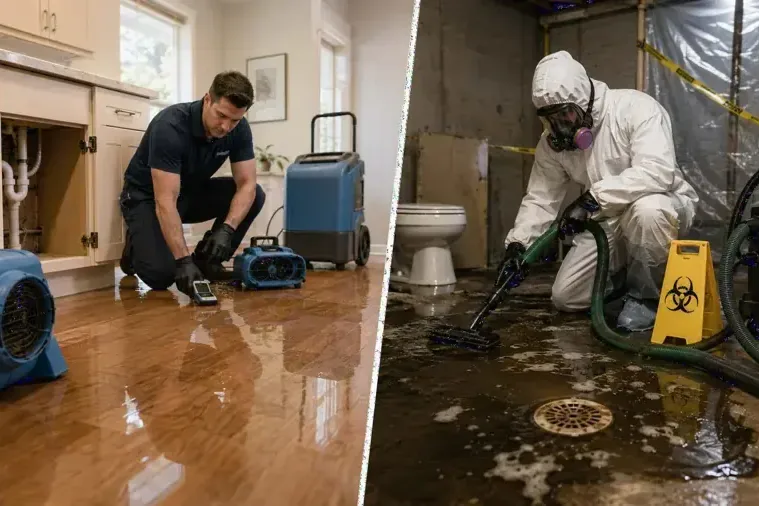
Why sewage backup cleanup needs a measured dry-out
- Dispatch around the clock. Active water is treated as urgent at any hour, weekends and holidays included, because drywall and subfloor keep wicking until extraction starts.
- Sized to the class of loss. Air movers and LGR dehumidifiers are set by the class of loss under the IICRC S500 drying standard, not by a guess.
- Readings decide the finish. Daily moisture readings track each wet material until it sits within 2 to 4 points of a dry reference in the same home.
- A claim file built during the work. Moisture maps, psychrometric logs and timestamped photos taken before demolition give the adjuster a clear record.
- Lower levels checked, not assumed. Sump pits, floor drains, wall bottoms and the slab edge get metered, not just the spot where water showed up.
First steps for sewage backup cleanup
- Stop using water. Skip flushing, showers, laundry and the dishwasher while the backup is active.
- Keep people and pets out. Contaminated water is a health risk, so seal off the room if possible.
- Avoid contact. Do not touch the water or wet items without proper protective gear.
- Photograph from a distance. Record the damage for the claim, then request professional cleanup.
What does sewage backup cleanup cost in Smithville, MO?
Sewage backup cleanup usually costs between $2,500 and $15,000 or more, depending on the area affected, how far the water spread and how much material must be removed.
Small backup, hard floor
- Waste water removed
- Floor sanitized
- Protective gear used
Finished room
- Carpet and pad bagged out
- Low drywall cut away
- Sanitizing applied
Whole basement
- Containment set
- Wide material removal
- Final clearance readings
Ranges are typical, not a quote: category of water, square footage, material class and how fast drying started move the number most. Run the water damage cost calculator for a closer range.
How sewage backup cleanup is handled, step by step
Contain
The area is isolated from clean rooms.
Remove
Contaminated water and materials come out.
Sanitize
Surfaces are cleaned and disinfected.
Dry
Equipment runs until readings are normal.
Wastewater that comes back up through a drain, tub or toilet is not ordinary water damage. It carries bacteria, viruses and other organisms, and anything porous that it touched is considered contaminated. Quick action matters, but safe action matters more.
Why this is handled differently
Clean water can often be dried and kept. Sewage cannot, so the plan is built around containment, removal and sanitizing rather than saving materials. Sewage from a drain backup is treated as contaminated until proven otherwise.
- Carpet, pad and low drywall are removed and bagged
- Affected hard surfaces are cleaned and disinfected
- The area is sealed off from clean rooms
- Anyone entering wears protective gear
Sewage coming up through a drain or toilet? Stay out and keep others away.
(888) 603-7319Get sewage cleaned up safelyA note on the municipal side
A published summary of Smithville's capital improvement plan lists wastewater work, including lift station projects. That is planning at the system level. A backup inside a house still needs sanitary cleanup and safe disposal of the contaminated materials, whatever the cause.
After the sanitizing
Once contaminated materials are out, the structure is cleaned, treated and dried with air movers and dehumidifiers until readings are normal. Cleaning products are used with care and the space is ventilated while work is under way. Do not run water or flush while a backup is active. For the extraction side, see water extraction, and for a backup that fills a lower level, see basement flooding cleanup.
Sewage backup cleanup across Smithville and nearby communities
Wherever a drain or toilet has pushed wastewater back into a building, sanitary cleanup is available across Smithville, including the Main Street area, Route DD and the west side along U.S. Route 169.
The same service nearby: sewage backup cleanup in Liberty, Kearney, Gladstone.
Sewage Backup Cleanup questions in Smithville, MO
Still dealing with it?
Sewage coming up through a drain or toilet? Stay out and keep others away.
(888) 603-7319 Get sewage cleaned up safelyIs sewage backup dangerous?
Yes. It carries bacteria and viruses that can make people sick, so contact should be avoided and cleanup should use proper protective equipment.
Can carpet be cleaned after sewage?
Generally no. Carpet and pad that touched sewage are removed and discarded, since they cannot be made reliably safe.
Should the cause be fixed first?
The cause needs attention, and a plumber handles that. The cleanup crew handles the contaminated water and materials already inside.
How is the area made safe afterward?
Contaminated materials are removed, surfaces are cleaned and disinfected, and the structure is dried. Final readings confirm it is ready for repair.
How long does sewage cleanup take?
A small backup on a hard floor can be cleaned in a single visit, while a finished space needs removal, sanitizing and then several days of drying with readings taken along the way.
Can people stay in the house?
It depends on the size of the backup. Bathrooms and lower levels are usually sealed off, and anyone with health concerns, young children or pets should stay clear until the area is cleared.
Does insurance cover sewage backup?
Coverage varies, and many policies treat it separately. Keep photos, a materials list and the drying records so the adjuster has everything.
Backed up wastewater is not a mop and bucket job.
The cleanup team contains the area, removes contaminated materials and sanitizes before the structure is dried.
(888) 603-7319Request sanitary cleanup