Structural Drying in Smithville, MO
Structural drying removes moisture left in framing, subfloors and drywall after the visible water is gone. Monitoring until the readings are dry prevents hidden damage in a Smithville building.
(888) 603-7319Get the building dried out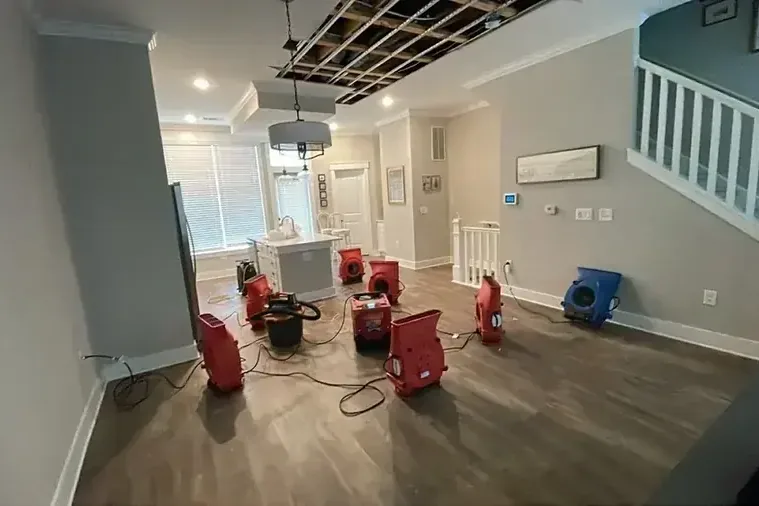
Why structural drying and dehumidification needs a measured dry-out
- Dispatch around the clock. Active water is treated as urgent at any hour, weekends and holidays included, because drywall and subfloor keep wicking until extraction starts.
- Sized to the class of loss. Air movers and LGR dehumidifiers are set by the class of loss under the IICRC S500 drying standard, not by a guess.
- Readings decide the finish. Daily moisture readings track each wet material until it sits within 2 to 4 points of a dry reference in the same home.
- A claim file built during the work. Moisture maps, psychrometric logs and timestamped photos taken before demolition give the adjuster a clear record.
- Lower levels checked, not assumed. Sump pits, floor drains, wall bottoms and the slab edge get metered, not just the spot where water showed up.
First steps for structural drying and dehumidification
- Keep doors closed. Closed doors and windows let the dehumidifiers work on the wet air.
- Leave it running. Switching equipment off to save power only slows the drying.
- Mind the cords. Route foot traffic around equipment and cords and keep pets away.
- Expect noise. The room turns warm and dry and the equipment hums, which is normal.
What does structural drying and dehumidification cost in Smithville, MO?
Structural drying usually costs between $1,000 and $7,500 or more, depending on the drying class, the number of rooms and how dense the wet materials are.
Class 1 to 2, one room
- Air movers and dehumidifier
- Daily readings
- Final dry check
Class 2 to 3, several rooms
- Multiple air movers
- Wall bottoms opened
- Readings each visit
Class 4, dense materials
- Specialty drying plan
- Hardwood and concrete monitored
- Extended run time
Ranges are typical, not a quote: category of water, square footage, material class and how fast drying started move the number most. Run the water damage cost calculator for a closer range.
How structural drying and dehumidification is handled, step by step
Map
Meters and thermal readings find the wet areas.
Place
Air movers and dehumidifiers go where the water is.
Monitor
Readings are taken and equipment is adjusted.
Release
Equipment leaves when targets are met.
Water that has been pumped off the floor has only started its way out of the building. Wood, drywall and concrete hold moisture long after the surface looks dry, and structural drying is the stage that removes it.
How the drying works
Air movers push dry air across wet surfaces so water leaves the material as vapor. Dehumidifiers pull that vapor out of the air so it cannot settle into other rooms, and the equipment is repositioned as readings change.
- Air movers lift moisture off floors and walls
- Dehumidifiers remove it from the air
- Wall bottoms and subfloors are opened when needed
- Meters and thermal readings direct each visit
Floors feel dry but the walls still read wet? The drying is not done.
(888) 603-7319Finish the drying rightLight losses and heavy ones
Jobs are sorted by how much water the materials absorb. A lighter loss may involve a single room, while the heaviest involve dense materials such as hardwood, plaster and concrete that release water slowly. Lower levels with concrete are covered under basement flooding cleanup.
When the equipment comes out
Equipment leaves only after the readings in each material reach the dry target set at the start. Pulling it early is how damp framing ends up behind a closed wall. For the first stage, see water extraction.
Structural drying and dehumidification across Smithville and nearby communities
Structural drying equipment is set up throughout Smithville, from the Main Street area to Route DD and the west side along U.S. Route 169, wherever water has soaked into framing, walls and floors.
The same service nearby: structural drying and dehumidification in Liberty, Kearney, Gladstone.
Structural Drying and Dehumidification questions in Smithville, MO
Still dealing with it?
Floors feel dry but the walls still read wet? The drying is not done.
(888) 603-7319 Finish the drying rightHow is it known when drying is finished?
Each material has a dry target, and meters confirm the readings reach it. A floor that feels dry to the touch is not proof, since subfloors and framing can lag behind the surface.
Why does equipment run around the clock?
Moisture keeps moving as long as the air allows it. Constant airflow and dehumidification dry faster than stopping and starting, and shorter drying lowers the risk of damage.
Are the noise and heat normal?
Yes. Dehumidifiers produce warm, dry air, and the air movers are loud. Both are signs the drying is working.
Can drying save hardwood floors?
Sometimes. Quick removal and controlled drying can save hardwood that has not cupped badly, though heavily swollen boards may need replacement.
Why are walls sometimes opened for drying?
Air cannot reach a wet cavity through solid drywall. Small holes or removed baseboards let airflow in, which dries framing and insulation much faster than leaving the wall closed.
Does drying always follow extraction?
Always. Extraction takes out the loose water, and drying handles the moisture inside materials. Skipping the second stage leaves hidden dampness.
Moisture left inside the walls and floor causes the worst damage later.
The drying team sets equipment, takes readings at every visit and pulls it only when the whole structure reads dry.
(888) 603-7319Request structural drying