Structural Drying and Dehumidification in Gladstone, MO
Structural drying removes water from framing, subfloors and walls with air movement and dehumidification, with moisture readings taken at each visit so the building is dry before anything is rebuilt.
(888) 603-7319Get the building dried properly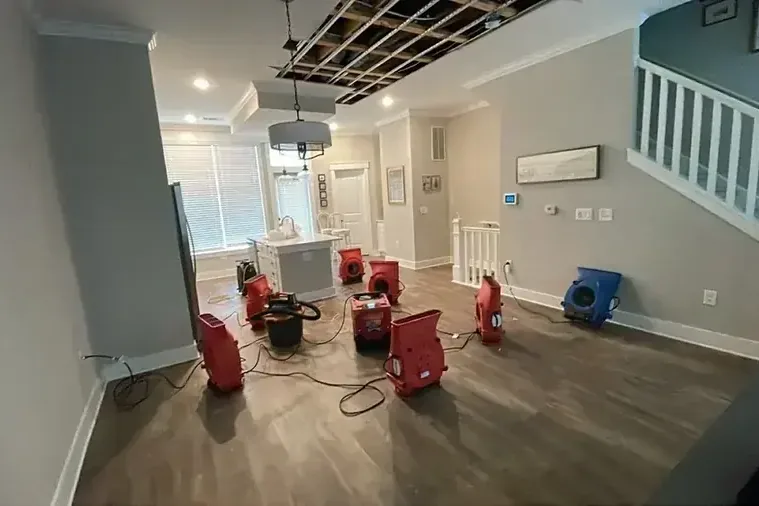
Why structural drying and dehumidification needs a measured dry-out
- Dispatch around the clock. Active water is treated as urgent at any hour, weekends and holidays included, because drywall and subfloor keep wicking until extraction starts.
- Sized to the class of loss. Air movers and LGR dehumidifiers are set by the class of loss under the IICRC S500 drying standard, not by a guess.
- Readings decide the finish. Daily moisture readings track each wet material until it sits within 2 to 4 points of a dry reference in the same home.
- A claim file built during the work. Moisture maps, psychrometric logs and timestamped photos taken before demolition give the adjuster a clear record.
- Lower levels checked, not assumed. Sump pits, floor drains, wall bottoms and the slab edge get metered, not just the spot where water showed up.
First steps for structural drying and dehumidification
- Keep the temperature steady. Leave heating or cooling running so warm air can carry moisture out.
- Open closed doors. Let air reach closets, cabinets and wall bottoms.
- Stay off wet floors. Foot traffic pushes moisture deeper into carpet and subfloors.
- Leave equipment running. Do not switch units off. Report any tripped breaker.
What does structural drying and dehumidification cost in Gladstone, MO?
Structural drying usually costs between $1,000 and $7,500, depending on the drying class, how many rooms are wet and how dense the materials are, such as concrete or hardwood.
Class 1 to 2, one room
- Air movers on wet surfaces
- One dehumidifier running
- Daily meter readings
Class 2 to 3, several rooms
- Cavities opened for airflow
- Multiple dehumidifiers
- Readings logged each visit
Class 4, dense materials
- Specialty drying for slow materials
- Extended equipment time
- Moisture mapped daily
Ranges are typical, not a quote: category of water, square footage, material class and how fast drying started move the number most. Run the water damage cost calculator for a closer range.
How structural drying and dehumidification is handled, step by step
Place
Set air movers and dehumidifiers across the wet area.
Run
Keep the equipment working around the clock.
Measure
Take moisture readings at every visit.
Remove
Pull the equipment once readings match dry.
Wet materials do not dry just because the water is gone. Framing, subfloors and the back of the drywall hold moisture that air movement and dehumidification have to pull out over several days.
How the equipment works together
Air movers blow dry air across wet surfaces and lift moisture into the room air. Dehumidifiers then collect that moisture so it cannot settle on other materials, and the balance of the two is adjusted at every visit.
- Air movers aimed at wet floors and wall bottoms
- Dehumidifiers sized to the volume of the space
- Cavities opened so air can reach framing
- Daily readings to adjust the equipment
Building still damp after the water is out? The drying team can set up equipment and track the readings.
(888) 603-7319Begin the building drying planHow drying is measured
Meters read moisture content in wood, drywall and concrete, and the readings are compared with dry areas of the same building. Equipment stays until the numbers match, not for a set number of days.
After the water is out
Drying follows water extraction and removal on most jobs and often leads into repairs. The structural drying service and commercial water damage use the same method. Repairs start only after the readings are normal.
Structural drying and dehumidification across Gladstone and nearby communities
Structural drying runs in homes and small buildings along Route 1, Route 283 and North Oak Trafficway, across ZIP codes 64118 and 64119, wherever walls and floors need to be dried back to normal.
The same service nearby: structural drying and dehumidification in Liberty, Kansas City, Smithville.
Structural Drying and Dehumidification questions in Gladstone, MO
Still dealing with it?
Building still damp after the water is out? The drying team can set up equipment and track the readings.
(888) 603-7319 Begin the building drying planHow long does structural drying take?
Most jobs run three to five days, depending on the materials and the amount of water. Dense materials such as hardwood or concrete take longer, and the readings decide when the equipment leaves.
Why are so many machines running?
Each machine has a job. Air movers lift moisture off surfaces, dehumidifiers pull it out of the air, and together they dry materials faster than either alone.
Does the equipment use a lot of power?
It does draw power, but drying only works if the units stay running. They are placed to cover the wet area without overloading a circuit.
Can wet drywall or flooring be saved by drying?
Often, if the water was clean and drying began quickly. Materials that stay saturated, or that held contaminated water, are removed instead.
How is the building known to be dry?
Meters compare wet areas with dry reference readings from the same building. When the numbers match, the equipment is removed.
What are the drying classes?
They sort losses by how much water there is and how dense the materials are, from Class 1 for light absorption to Class 4 for dense materials like hardwood or concrete.
Wet framing and floors? Dry the building itself.
Surface drying leaves moisture inside walls and subfloors. The drying team places equipment and measures until it is gone.
(888) 603-7319Call about the drying